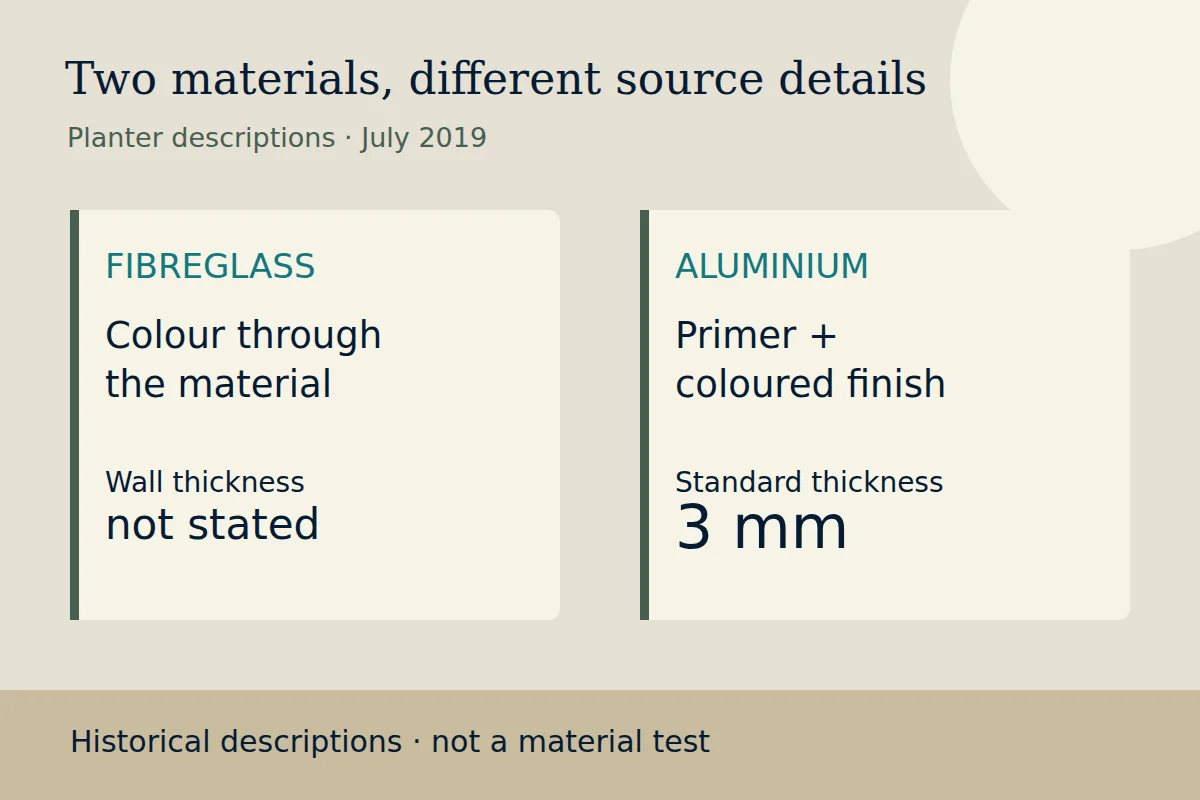
The old One to Sit planter page describes two different ways of making a coloured container. Its fibreglass section says that colour runs through the material. Its aluminium section describes a primer and a coloured coating applied after construction. That distinction is more useful than the shared promise of a wide colour choice: a surface and the material beneath it are different parts of the specification.
This guide reads the English planter description captured on 24 July 2019. It preserves the former supplier’s stated construction, finish and care information. It is a historical reference, not a test of those claims or a specification for an unidentified planter in use today.
Two material descriptions, with different levels of detail
The fibreglass text describes reinforcement at the corners and colouring through the material. It gives no wall thickness. The aluminium text, by contrast, states a standard thickness of 3 mm and says that 4–5 mm versions could also be produced. Those are options in the old description; they do not establish the thickness of every planter sold under the name.
For aluminium, the page also specifies 15 mm feet and describes a powder-coating process after construction, with an adhesive primer and a coloured finish. The feet are a separately stated feature. The source does not turn their height into a drainage capacity, a levelling adjustment or a guarantee that any particular surface is suitable.
Both sections describe an upper edge turned back twice. That shared wording should stay alongside the two different material descriptions. It does not establish that the edges were made by the same process or that the finished products had identical stiffness. No comparative load test or structural calculation appears in the retrieved page.
A RAL number identifies a colour reference, not the construction
The page’s standard and optional colour lists are not identical:
| Material | Listed as standard | Other colours described |
|---|---|---|
| Fibreglass | RAL 7021 | RAL 7006, 7016, 7035, 9005 and 9010; the old text states a 10% surcharge. |
| Aluminium | RAL 7021, 7035 and 9010 | Almost all other RAL colours, with a warning about start-up costs. |
RAL 9010 is a useful example of why the columns matter. It appears among the additional fibreglass colours but among the standard aluminium colours. A note containing only “9010” would lose both the material and the historical ordering condition. The surcharge and start-up wording belong to this dated source; they are not present prices.
The general model overview captured in August 2019 uses a much broader colour statement around its collection entries. The detailed planter page supplies the more specific distinctions above. Neither page establishes which colours or finishes a supplier offers now.
The care paragraph applies to the fibreglass section
The former supplier recommended cleaning the fibreglass planters at least twice a year. The same paragraph warned against steel wool, sandpaper, solvents and other abrasive materials, and said that pressure washing could cause damage. It also promoted a care set through an accessories page.
Keep that paragraph attached to its heading. The retrieved aluminium section does not repeat an equivalent care procedure. Absence of a second paragraph is not evidence that the same chemicals or cleaning method suit both finishes. Nor does the old reference to a care set reveal its ingredients or identify a product currently on sale.
For a planter whose finish has been repainted or otherwise changed, the old material label alone is an incomplete basis for care. The useful next document is the care instruction for the actual finish. This article records the historical guidance; it does not add a cleaning recipe that the source never supplied.
“65 models” is a range claim, not a recovered model list
The August overview advertises 65 models across fibreglass and aluminium and mentions customisation. The detailed page recovered here explains the two materials but does not enumerate those 65 models. There are no 65 names or size records to reproduce from these two sources.
That matters when interpreting an old catalogue reference. A claim about the size of a range cannot identify an individual planter, and the offer of customisation cannot supply the dimensions of a custom order. We retain both statements as descriptions of the former offering, without turning them into a complete reconstructed catalogue.
Turn the description into a precise identification note
A useful note separates four questions: which model or order is involved; what material and finish are documented; which dimensions are actually known; and which record supplies each answer. For example, “aluminium, RAL 9010, thickness not yet confirmed” is more informative than importing the standard 3 mm figure into a record for an unknown object. This is an illustrative note, not a recovered customer order.
Both historical material sections mention a five-year warranty. The retrieved page does not supply the full terms or establish coverage for a current owner. The statement is retained as part of the old description, not presented as an active warranty.
The original text is available, but its associated image has not been recovered. The illustration here compares selected source statements; it is not a cross-section or a manufacturing drawing. The 2019 model index places the planter entry beside the furniture references; the aluminium-table guide shows why material statements for a table should remain separate from those for a planter.